
aspects of this site are under construction, some links may be broken

Felice Casorati in studio,, 1919
The Beginning
Studio Museo Felice Casorati
Pavarolo, Italy
Fall 2024
the work of Luisa Rabbia in dialogue with
Huma Bhabha, Ross Bleckner, Gianni Caravaggio, Mario Diacono, Jason Dodge, Scott Grodesky, Jannis Kounellis, Piero Manzoni, Claudio Pamiggiani, Beatrice Pediconi
David Dixon
visiting curator

Luisa Rabbia, Birth, 2017

Jason Dodge, Luisa Rabbia, Birth, 2017

Jason Dodge, In Helsinki, Henni Aarnio wove a cloth made from thread the color of night and the distance from the earth to above the weather, 2010

The plumb bob from Mario Diacono's Fertility

from left, Beatrice Pediconi, Jannis Kounellis, Scott Grodesky, Gianni Caravaggio, Jason Dodge, Giuseppe Bellone


Claudio Parmiggiani, Synecdoche, 1976
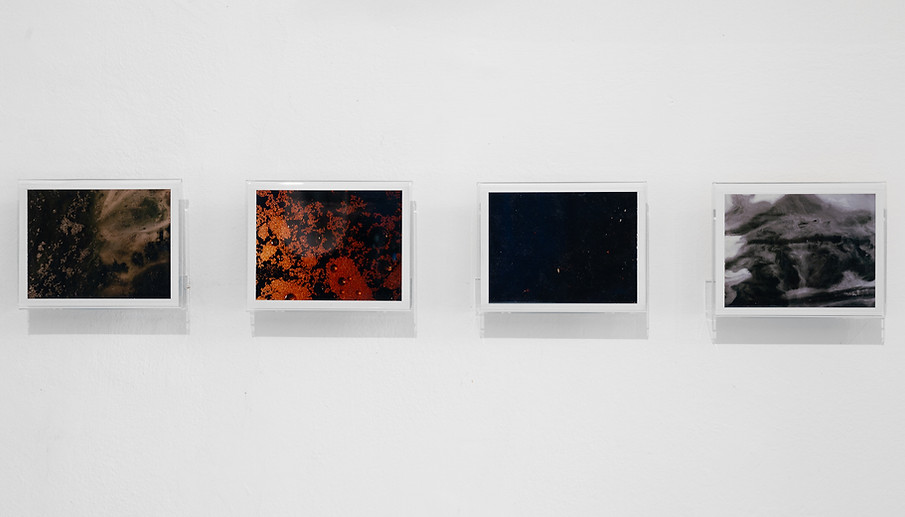
Beatrice Pediconi, Polaroid #7, #4, #1, #16, 2013
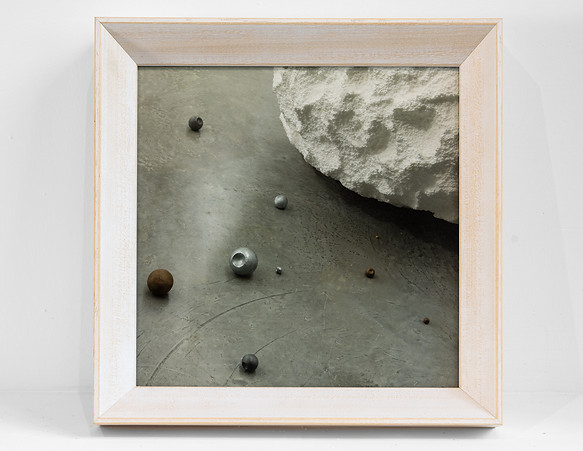
Gianni Caravaggio, Poco dopo, 2008
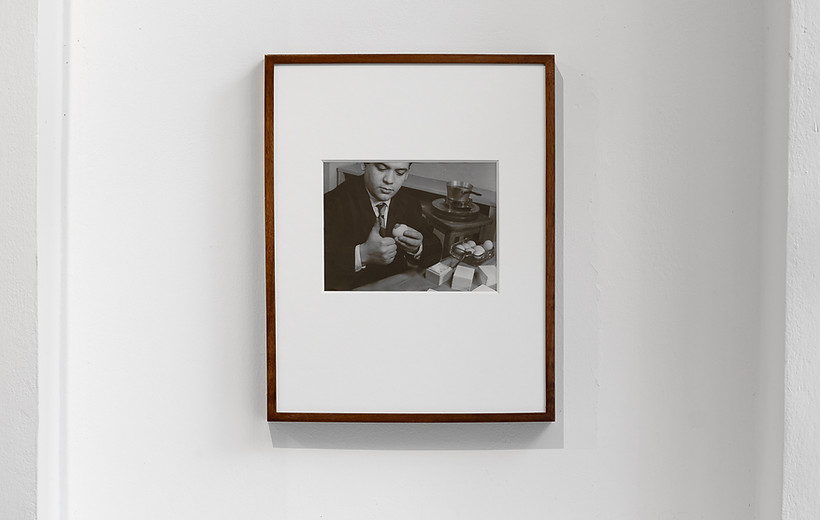
Giuseppe Bellone, Piero Manzoni, 1960

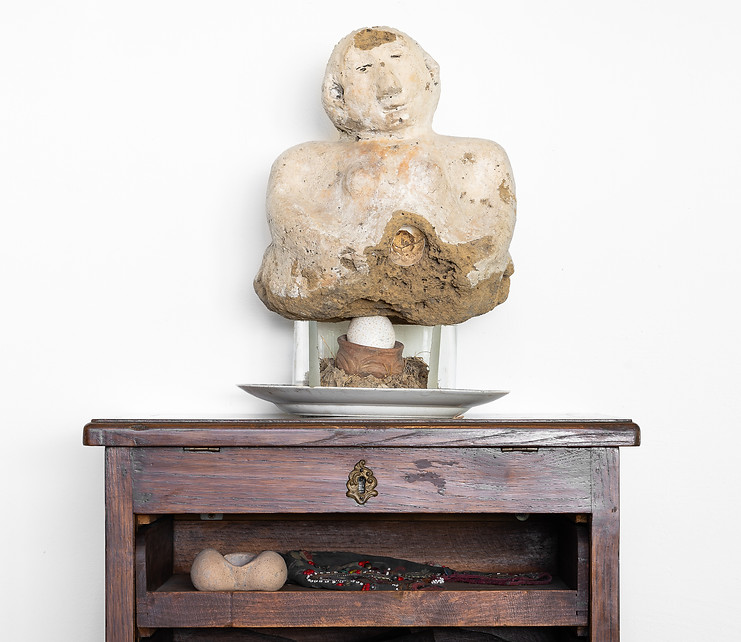
Mario Diacono, Fertility, 1980-84


Huma Bhabha, Untitled, 2011

Luisa Rabbia, NorthEastSouthWest, 2014


Claudio Parmiggiani, Untitled (Dies nostri quasi umbra super terram et nulla est mora – Krakow), 1975
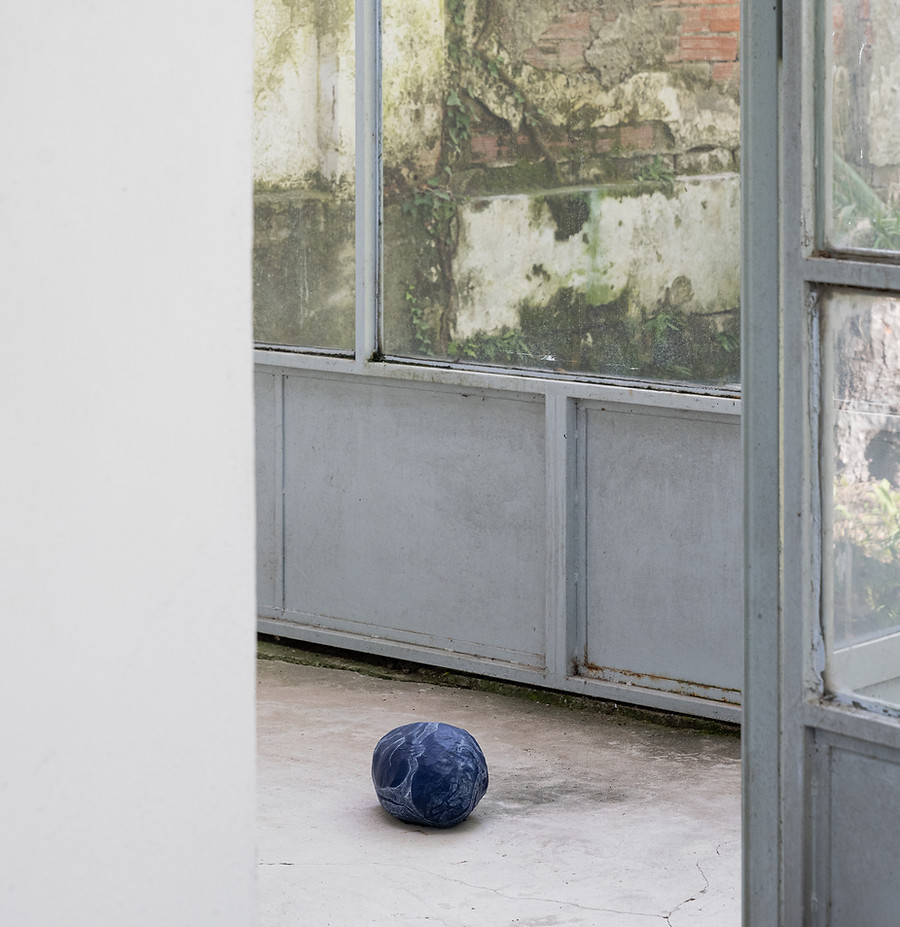
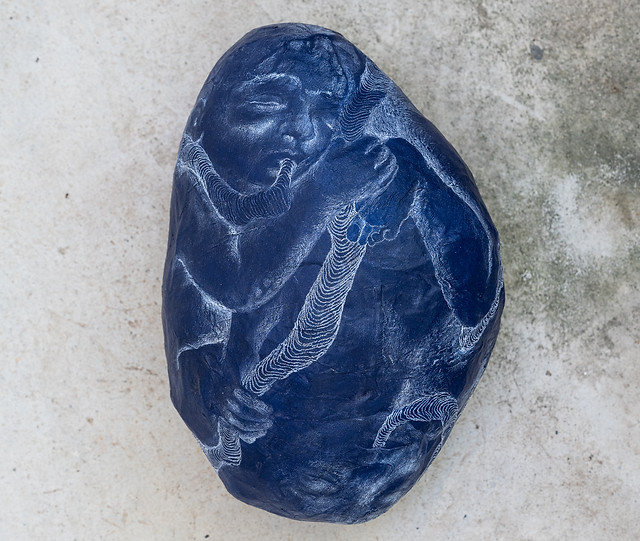
Luisa Rabbia, Twins, 2009
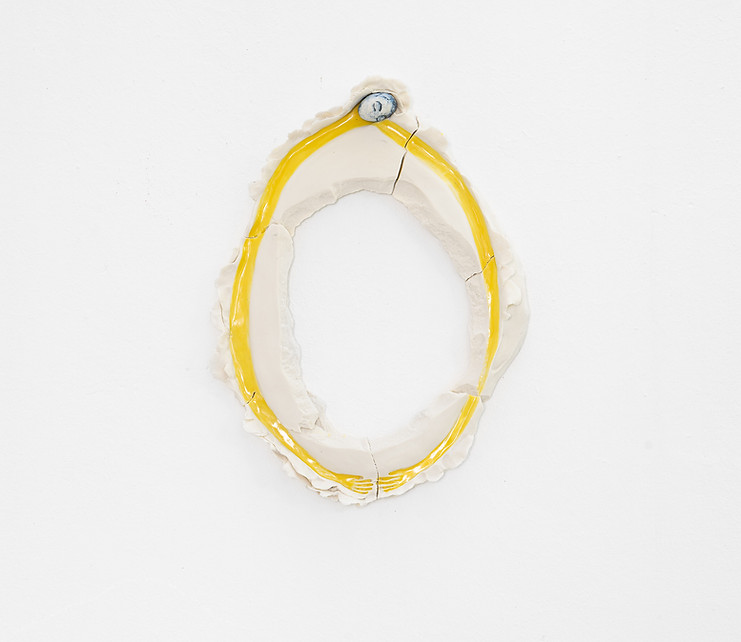
Luisa Rabbia, Hollow, 2021
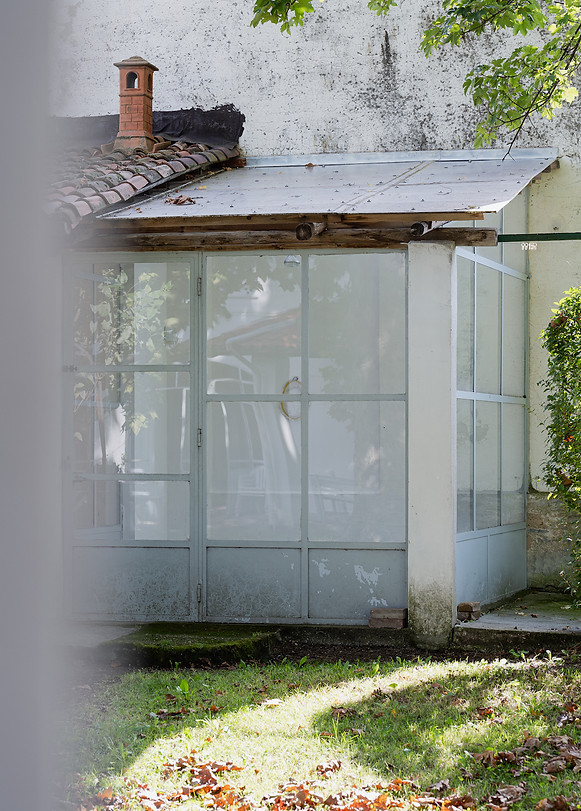
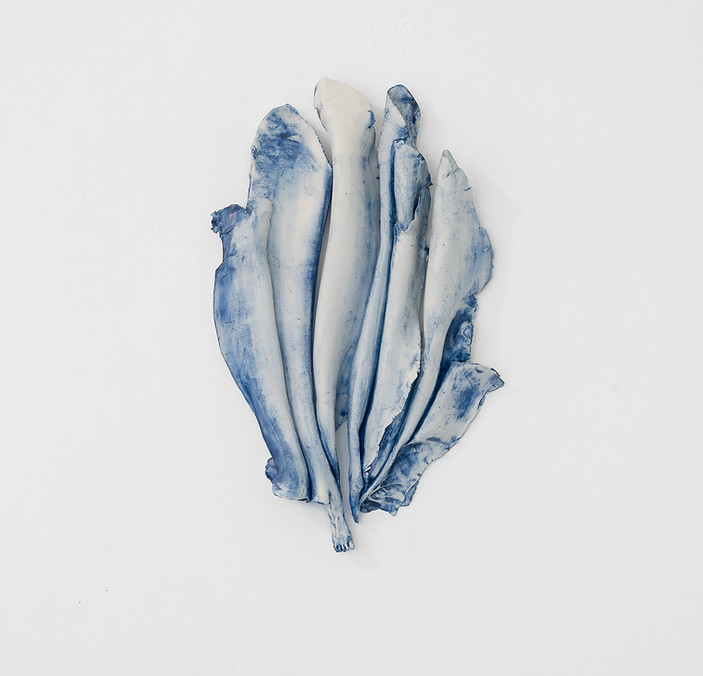
Luisa Rabbia, Being, 2022
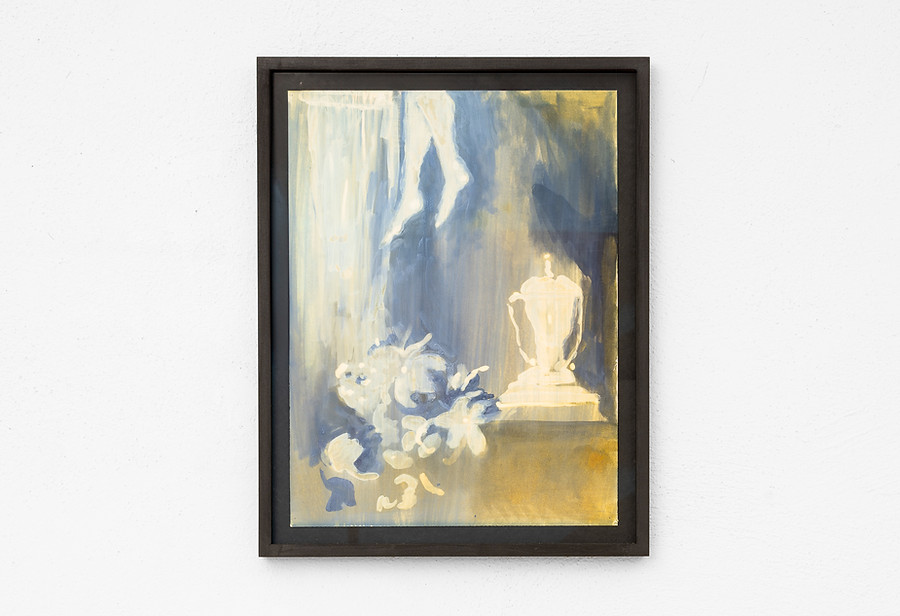
Ross Bleckner, After "One Day Fever", 1987

Luisa Rabbia, Studies for Love, Death, Birth, 2016, 2017
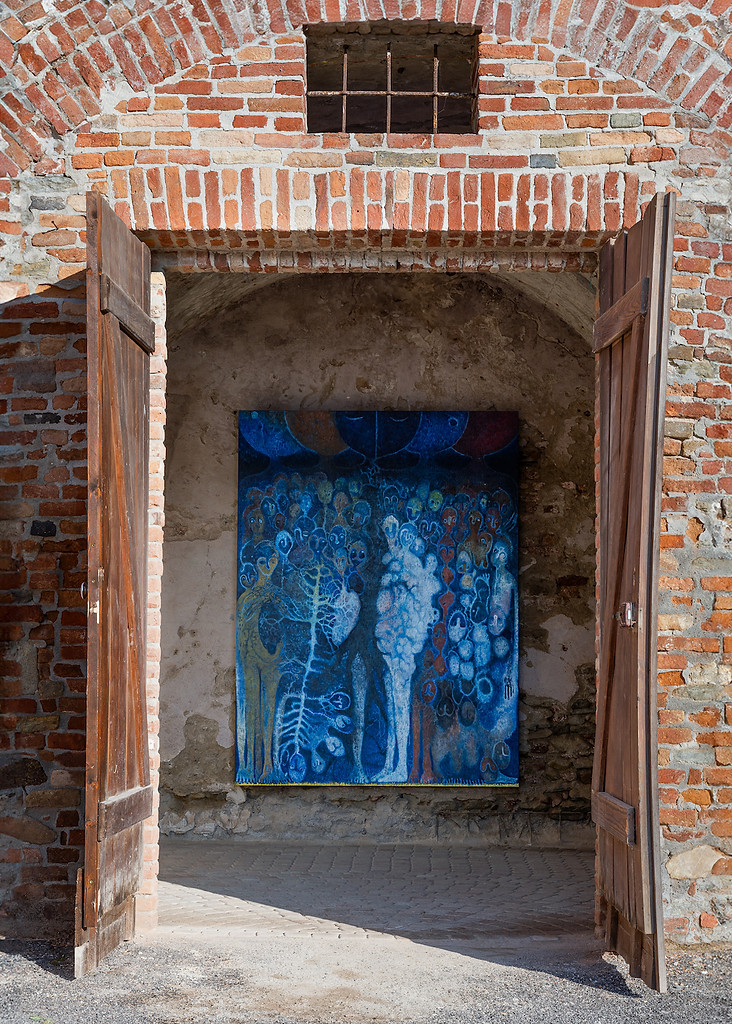
Luisa Rabbia, The Gods, The Beginning, 2024

Catalogue essay by curator David Dixon
The group exhibition,The Beginning, begins with two major paintings by Brooklyn-based artist, Luisa Rabbia, NorthEastSouthWest (2014) and Birth (2017), loaned from Collezione Maramotti in Reggio Emilia and Collezione Francesca Lavazza in Turin, respectively. These sizable works set the tone for the exhibition’s subsequent selections that have been chosen from Collezione Maramotti’s available holdings. The Beginning marks a return for the Italian-born Rabbia who emigrated to New York from Turin in 2000, and presents artworks of her’s in concert with relevant historic and mid-career artists including Huma Bhabha, Ross Bleckner, Gianni Caravaggio, Mario Diacono, Jason Dodge, Scott Grodesky, Jannis Kounellis, Piero Manzoni, Claudio Parmiggiani, and Beatrice Pediconi.
The exhibition spans three distinct spaces in Pavarolo, the Studio Museo Felice Casorati’s two exhibition spaces—the former studio of Casorati and his adjacent villa’s garden-level rooms—and an off-site, grotto-like space under the village’s clocktower. Consequently, the viewer can find themselves beginning the exhibition in any one of these three locations, the Garden, the Grotto, or the Studio. In other words, there is no one, single point of entry to The Beginning. The Beginning is various and it begins again and again.
If Rabbia’s work sets the tone for the exhibition, this unusual arrangement of exhibition spaces sets the pace. One begins again in the Garden, connected to nature and its cosmic longings. One begins again in the Grotto, laboring under the clock in a tomb-like, womb-like room. One begins again in the Studio, for always, for artists, this is the platform for renewal and discovery. In total, The Beginning simultaneously happens in these three spaces, and once begun promises to take the viewer beyond the stars to the mind where everything really is, a long way to travel unless, of course, we are already there! In any event, the following exhibited artworks will help us navigate the conundrums that, together, they collectively propose.
In the Garden:
Upon entering, the first works encountered are three, highly resolved studies on paper by Luisa Rabbia titled Love (2016), Death (2017), Birth (2017); the works are intentionally ordered as such by the artist to indicate a cycle, where Birth ends the series but also intimates the beginning of a new order. In our exhibition, the large-scale version of Birth, for which this one in the Garden is the study, is installed in the Studio. This is the first time that this series has been exhibited together, albeit here in study form. Ross Bleckner’s painting on paper, After "One Day Fever" (1987), hangs opposite the three studies, it asserts a different kind of motion, not a cycle, yet still a birth of sorts, only two feet remaining visible from a figure ascending or descending, into or out of frame.
The Beginning continues with Fertility which presents us with the first of what are several eggs or egg-like forms. Here the egg sits on a ceramic plate atop a bureau, incubated by a clay sculpture of West African origin. This is an assemblage created by poet, artist, and gallerist Mario Diacono, who, for the past several decades, has worked closely with Collezione Maramotti, our exhibition’s contributor. The bureau stands as a small tower of open faced drawers, which contain meaningful personal and historical objects arranged by Diacono dating back to the years he lived in Rome and Bologna, a period which also marks the beginning of his friendship with Achille Maramotti, the Collezione’s founder. Therein is the first monograph on Vito Acconci published by Diacono in 1975; a packet of Kodak slides labeled MAZA containing reproductions of Diacono’s object poems (styled “objtexts”); an etched metal plate and its related print of an alchemical drawing depicting the cosmos by Michael Maier; a Tibetan shaman’s belt; etc, etc. Indeed, this bureau with its collection of objects normally resides in Collezione Maramotti’s library, not in its galleries, performing there on a daily basis more as a talismanic memorial archive of the Collezione itself than as an “object of art” in the contemporary sense of the word. In this way, Fertility could be said to be the beginning of The Beginning; it functions here in the Garden as a generative force nested within our larger exhibition.
Adjacent to Fertility are two works that stimulate thinking beyond the presence of their material, and reiterate an ascending-descending motion along with that of cycles: a layered cosmic circling with an expanding empty center in Parmiggiani’s Untitled (Dies nostri quasi umbra super terram et nulla est mora – Krakow) (1975), translated from the Latin as “Our days are like a shadow upon the earth and there none stays” and Luisa Rabbia’s foliate ceramic form, Being (2022), with two feet emergent below.
With these works in mind one begins to feel light, even breathless, then Huma Bhabha’s portrait on paper, Untitled (2011), comes into view. Unsettling in its elemental form, Bhabha’s depiction is of a quasi-human face emerging from, or being pushed back into, darkness. Edvard Munch’s Scream comes to mind, perhaps now it too is in the room; one begins to hear it emit. Human struggle felt in the belly is brought up through the senses: We have come from far away. Across from Bhabha, Luisa Rabbia’s pulsing muscle, NorthEastSouthWest (2014), still in the belly opens like a diaphragm adding to the din. A rhythm begins to take shape, a repeated beat, as life pumps through tentacles to the four corners of the. . .globe? the painting? the body? the cosmos? Does the body have a North, an East? The cosmos a South, a West? Rabbia has been careful in the title to designate the four cardinal points in a clockwise motion: upper left ventricle, upper right ventricle, lower right ventricle, lower left; a cycle, once again, like Love, Death, Birth, or the tick of time itself.
We’ve come to the end of the first beginning in the Garden and we find two egg-shaped forms, both by Luisa Rabbia, one of which is Twins (2009) in papier-mâché, the other is Hollow (2022) in ceramic installed together in the Garden’s greenhouse. Twins is a solid, oval form that could fit nicely into Hollow’s exploded void, an anti-form that was produced by chance in the extreme heat of a kiln. The tubular shapes that were described above as “tentacles” in NorthEastSouthWest in Twins take on the implication of an umbilical cord connecting two exposed fetuses, both of which have the snaking form connected to the mouth, not the belly. The mirrored twins create a self-contained system of reflection or exchange, independent from a mother, evoking many historical “cosmic egg” creation myths that by necessity need answer the question of existence by getting something out of nothing. Or by extension, the inversion of this existential conundrum can be answered in Hollow: the mother of mystery embraces the ineffable from which all emerges. Further, twins in certain cultural traditions take on magical properties because of their doubled nature, much like humanity itself is doubled in its material and spiritual aspect. Perhaps, too, like Narcissus gazing into his own image; these two works by Rabbia reflect on the ability of artists to produce something where there was nothing—mirroring creation itself—drawing down inspiration from unknown reservoirs in themselves.
In the Studio:
Certainly, one’s first impression will be weighted by the mural-sized painting that almost completely fills the gallery’s main wall. This painting is Birth (2017), by Luisa Rabbia, and one might consider it, due to its size, subject, and position, the center-piece, not only of this room, but of the exhibition itself. Upon closer inspection, it will become evident that this painting is no painting at all but actually a drawing in colored pencil on dark blue acrylic. As seen in the Garden studies, this work was originally conceived and executed as part of a series of three equally ambitious canvases, Love (2016), Death (2017), and Birth (2017). This series marks the pinnacle of Rabbia's virtuosic use of pencil; soon after she begins to prioritize oil paint on canvas as demonstrated by the painting that hangs in the Grotto. In Birth, the entire underlying blue acrylic surface, which is then drawn upon, is pressed with countless, deep fingerprints, human traces evoking atmospheric dust or floating molecules. The most prominent fingerprint in this vast number of prints congeals in white and defines the artwork’s navel. The figure’s overall shape, horizontally orientated, is reminiscent of an alchemical beaker into which life flows, calling to mind Piero della Francesca’s Madonna del Parto, or body as temple.
Across the room from this single, mammoth Birth—perhaps the mother of us all—are many works by a wide variety of diverse artists arranged in a loose cluster. This cluster is rich in associations and interrelated forms, all of which, in one way or the other, speak back to the universal mother hanging across the room.
This installed cluster of works is complicated by the fact that Claudio Parmiggiani’s Synecdoche (1976) is, in and of itself, a cluster of several elements, in effect making it a cluster within our installed cluster. We can enjoy, on its own, the reproduced Dosso Dossi painting of 1524, which is a part of Synecdoche, in much the same way that we enjoy, for example, the photograph across the room of Manzoni putting thumb prints on eggs. Yet, the Dosso Dossi is first and foremost a part of Synecdoche, and we witness there Mercury—ancient myth’s escort of the dead—patiently waiting behind the painter as he paints the painting of three butterflies, which Parmiggiani makes physically manifest and leans against the wall. In front of the painting of butterflies is the absent painter’s stool, brushes and palette; it seems that Mercury has now taken the painter away. Here, in Felice Casorati’s former studio, this is an especially potent image. It might be helpful to say that a synecdoche is a figure of speech where a part of something is made to stand in for the whole, or, for our purposes, where the artist’s output—the painting of butterflies—stands in for the artist’s lived life.
These rather heady notions about mortality and the genesis of art in time and space lead us quite naturally into the arrangement of works on the opposite side of the room. There, one finds the photograph, already mentioned, by Giuseppe Bellone of artist Piero Manzoni in 1960 performatively imprinting his thumb onto various eggs. There are also several works that evoke stars or the cosmos. Jannis Kounellis’s Untitled (1977) has a rough, ruptured center, an aperture cut into the cosmos that seems just big enough to peer into, if there were something behind to see. Beatrice Pediconi’s photographed liquid paintings captured in a series of Polaroids from 2013 are a study in the universal becoming that is the becoming of form. Here, too, is Gianni Caravaggio’s photograph, Poco Dopo (2008) evoking that moment just after when form first starts to find its form, when chaos first starts to take a shape, when the corral first starts to contain the wild.
In the center of this constellation, overseeing these universal happenings, or emerging from their grace, we have Scott Grodesky’s work on canvas, Untitled (1991). Here is human form: a head, or two heads, a head containing a head, sharing an ear canal pinpointed in the center by an “X”. This “X” marking a spot is not unlike Leonardo Da Vinci’s famous drawing of the sensus communis, which attempts to mark humanity’s contested “common sense,” or soul, or our anima mundi, or, rather, that shared portion of animated world soul each of us gets to have at birth. Too much, really, to go into here, but Rabbia’s fingerprint in Birth pinpoints the navel that was the umbilical in the now pregnant belly; this could be said to be the bodily counterpoint to the continuum of soul pinpointed by Da Vinci, according to tradition, in the brain, and that Grodesky so meaningfully evokes with his portrait of a being inside of being, the twining of body and soul.
These reflections have taken us to certain heights and even depths, pulling us up through a center that must, by all accounts, be everywhere. But what of the plumb bob hanging conspicuously nearby, untitled for real because it is not listed as an artwork in the show? One might turn to Jason Dodge’s In Guatemala, Felipa Chonay wove a cloth made from thread the color of night and the distance from the earth to above the weather (2010) or his In Helsinki, Henni Aarnio wove a cloth made from thread the color of night and the distance from the earth to above the weather (2010). One might also notice, at the entrance to the Studio, a plumb bob being used by Rabbia in the photograph of the artist, up on a scaffolding, making Birth. One should also know that this specific exhibited plumb bob has been borrowed from the collection of objects stored in the drawers of Diacono’s Fertility in the Garden. In any event, the plumb bob has been activated, it marks its point, it finds its level. However, it took this curator some time, but I realized only recently that there is a relationship between the seemingly straight line of the earth’s horizon and the false vertical obtained by a dangling plumb bob. No doubt, all measures are equally troubled (like art itself, like justice itself), but relevantly so in the falteringly false realities that are inevitably revealed.
In the Grotto:
Under the watch of time we enter into the presence of Luisa Rabbia’s painting, The Gods: The Beginning (2024), the work that gives the name to this group exhibition. Recently painted prominently in blue (Rabbia’s primal color, the color she has been known for), she returns to the color of her earlier NorthEastSouthWest and Birth. This painting’s verticality confronts our standing vertical stature in front of it with the verticality of its own standing, and sometimes flipped, emerging subjects. Implying that we, too, are emerging, refugees from Eden, engulfed by the gods, or by this tomb-like, womb-like grotto, or by the time above, or by something more immense and surrounding than, certainly, our own imaginings.
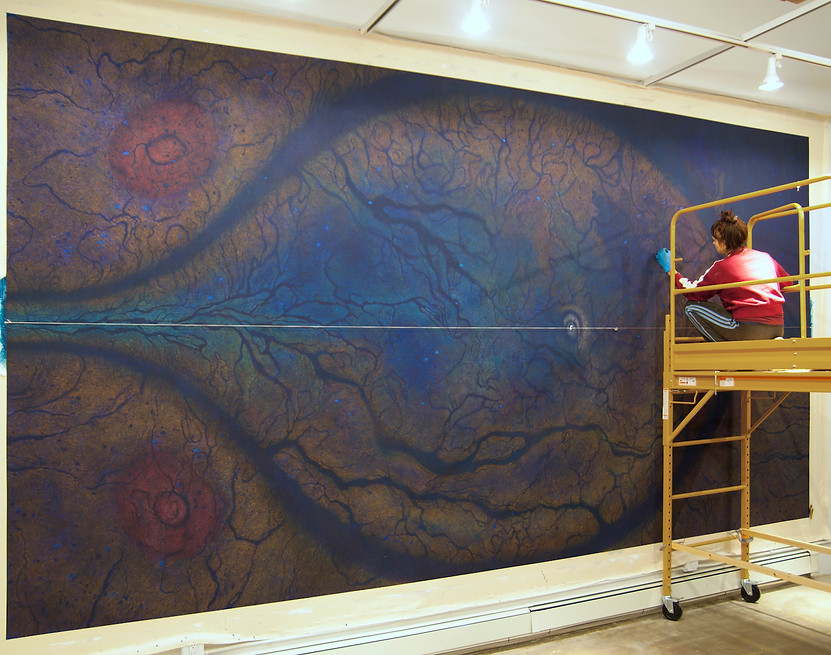
Luisa Rabbia in studio making Birth, 2017, Brooklyn, NY
